Key Takeaways
- A dental second opinion in Budapest can help you assess an expensive treatment plan, understand alternatives and clarify costs before committing to irreversible procedures.
- Compare the complete treatment – not just the headline price. Check extractions, grafting, implant components, temporary teeth, final restorations and follow-up fees.
- Different recommendations do not automatically mean one dentist is wrong. Ask each clinician to explain the diagnosis, the prognosis of remaining teeth and the trade-offs behind their approach.
- For a remote review, provide your existing plan, itemised quotation, relevant imaging and medical history. Recommendations remain provisional until an in-person examination.
- Check the reviewing clinician’s qualifications and commercial interests. A clinic offering treatment is not a fully independent assessor simply because its review is free.
- Agree on aftercare and complication management before travelling. Include flights, accommodation, maintenance and possible return visits when comparing total costs.
- The best outcome is a clearer, safer decision – not necessarily cheaper treatment or a different plan.
Dental Second Opinion in Budapest: Compare Your Treatment Plan with Confidence
A substantial dental quotation can leave you with more than a financial decision. You may be wondering whether every proposed extraction is necessary, whether implants are your only option, or whether the treatment could be completed more conservatively.
When the plan involves several thousand pounds, dollars or euros, uncertainty is understandable. You are being asked to approve procedures that may permanently change your mouth, often while managing pain, embarrassment or anxiety.
A second opinion gives you space to understand the recommendation before committing. It is not an accusation against your dentist, and it should not become a contest to find someone who promises the most treatment for the lowest price.
The purpose is to test the diagnosis, examine alternatives and clarify the relationship between clinical need and cost.
Budapest, Hungary, is an established destination for international dental patients, with providers offering implant surgery and complex restorative treatment. However, the city’s reputation does not replace the need to assess an individual clinician, treatment proposal and aftercare arrangement.
A useful Budapest review may confirm your local dentist’s plan. It may suggest preserving a tooth, changing the sequence, or choosing a different restoration. Occasionally, the most responsible recommendation is to complete initial treatment close to home.
The goal is not necessarily to receive a different answer. It is to receive an answer you understand.
1. Why Seeking Another Opinion Is a Sensible Step
Separate Financial Shock from Clinical Judgement
An expensive plan is not automatically excessive. Complex dentistry can involve extensive diagnostic work, specialist surgery, laboratory manufacturing and long-term clinical responsibility.
Equally, a lower quotation does not automatically represent equivalent treatment at a better price. Important items may be missing, or the proposed restoration may differ substantially.
Start by separating three questions:
-
What disease or structural problem needs treatment?
-
Which treatment options are clinically reasonable?
-
What would each complete option cost?
This sequence prevents price from determining the diagnosis.
Different Recommendations Do Not Necessarily Mean Someone Is Wrong
Dentistry often involves judgement rather than one unavoidable solution. A compromised tooth might be maintained with further treatment, monitored for a period, or extracted if its prognosis is poor.
Two clinicians may interpret the same situation differently because they place different weight on longevity, surgical burden, maintenance or your preferences.
Ask each clinician to explain the reasoning and uncertainty. A balanced recommendation should acknowledge alternatives, including their disadvantages.
Recognise When a Review Is Particularly Valuable
Consider another opinion before:
-
Removing several remaining teeth.
-
Accepting a full-arch implant reconstruction.
-
Undergoing extensive grafting or sinus surgery.
-
Replacing serviceable restorations primarily for appearance.
-
Agreeing to a plan you cannot clearly explain back to the clinician.
Do not delay urgent treatment for spreading infection, significant swelling or uncontrolled pain while collecting quotations.
2. Understanding Your Existing Dental Treatment Plan
A treatment plan should describe more than a list of procedures. It should connect your diagnosis to a sequence of care, explain the expected outcome and identify foreseeable changes.
Diagnostics: Establishing What Actually Needs Treatment
Assessment can include an examination, periodontal measurements, photographs, bite assessment and appropriate radiographs.
For implant planning, a cone-beam CT scan, or CBCT, can provide three-dimensional information about bone and nearby structures. It complements the examination; it does not replace assessment of gum health, tooth mobility or your ability to clean a proposed bridge.
Ask which findings support each major recommendation. A clear explanation is more useful than an impressive-looking scan alone.
Extractions: Clarifying Which Teeth Cannot Be Maintained
Every proposed extraction deserves an explanation, particularly when several teeth are involved.
Ask whether the concern is decay, fracture, advanced gum disease, persistent infection or an unfavourable restorative prognosis. “Weak teeth” is not a sufficiently precise explanation for an irreversible decision.
Also distinguish a tooth that cannot reasonably be restored from one that could be retained but would complicate a preferred bridge design.
Bone Grafting and Sinus Lifts
Grafting may be recommended to improve the amount or configuration of bone available for implants.
Your plan should identify the site, procedure and timing. It should explain whether grafting occurs during implant placement or requires a separate healing stage.
If a second clinician proposes avoiding grafting, ask what changes make this possible. A different implant position or restoration may introduce trade-offs elsewhere.
Implant Fixtures, Abutments and Replacement Teeth
The implant fixture is the component placed in bone. The abutment connects the implant to the restoration, while the crown or bridge provides the visible replacement teeth.
A healing abutment helps shape or maintain the gum opening during healing. It is not necessarily the definitive abutment used for the final tooth.
A quotation stating “implant included” may therefore cover only part of the reconstruction.
Temporary and Definitive Restorations
Temporary teeth help manage appearance and function during treatment. Their materials, strength and intended lifespan may differ from the definitive restoration.
Clarify whether the fee includes a removable denture, a fixed temporary bridge, the final bridge, and any planned replacement of the provisional restoration.
Checklist for Reading Codes and Terminology
Request a plain-English version of the quotation and check:
-
Which tooth or jaw region each item concerns.
-
Which tooth-numbering system is being used.
-
Whether charges are per implant, tooth, bridge unit or complete arch.
-
Whether “crown” refers to a natural tooth or an implant.
-
Whether extraction, grafting and sedation are separate.
-
Whether temporary teeth and final teeth are both included.
-
Whether scans, reviews and adjustments attract additional fees.
-
Which items are provisional allowances rather than fixed prices.
A code identifies a billed procedure; it does not establish why you need it.
3. Comparing Local and Budapest Plans Without the Apples-to-Oranges Trap
The most misleading comparison is often also the simplest: placing two totals beside each other without checking what they purchase.
A useful comparison examines the clinical destination, treatment sequence and continuing responsibilities.
Build a Like-for-Like Comparison
Use the following framework for your local quotation and the Budapest proposal.
| Comparison point | Information required from both providers | Why it matters |
|---|---|---|
| Diagnosis | Findings supporting each major intervention | Similar prices can conceal different assumptions about your condition |
| Teeth retained or removed | Tooth-by-tooth prognosis and justification | Extraction is irreversible |
| Implant system | Manufacturer, product line and component availability | Brand names alone do not describe the complete system |
| Implant quantity and position | Number, distribution and supporting rationale | More implants do not automatically create a better restoration |
| Final restoration | Fixed or removable, material and design | Different prostheses provide different function and maintenance demands |
| Temporary teeth | Type, duration and replacement arrangements | Provisional treatment can represent a substantial additional cost |
| Grafting | Sites, technique and timing | Extra surgical stages affect risk, travel and expenditure |
| Warranty | Duration for each component, exclusions and claim process | A long headline warranty may offer limited practical coverage |
| Visits | Number of trips, appointment days and contingency visits | Travel costs depend on the complete pathway |
| Maintenance | Review intervals, cleaning and likely replacement parts | Long-term ownership extends beyond initial treatment |
Compare Implant Systems Without Buying a Logo
Straumann and Nobel Biocare are examples of established implant manufacturers. However, specifying a recognised manufacturer does not guarantee an appropriate diagnosis, accurate placement or well-designed bridge.
Ask for the exact implant line and whether compatible restorative components are readily available where you live.
A less expensive system should not automatically be dismissed. The relevant questions concern supporting evidence, traceability, component supply and the treating team’s experience.
Conversely, a premium brand should not be used to justify unexplained treatment or an incomplete quotation.
Compare the Final Bridge, Not Just the Implants
An acrylic-based provisional bridge, a reinforced definitive prosthesis and a zirconia bridge are not interchangeable products.
Their repair options, weight, space requirements, opposing-tooth considerations and replacement costs differ. “Premium teeth” does not identify a material or explain why it suits your mouth.
Ask how the proposed bridge accommodates cleaning, speech, lip support and future repairs. These practical factors may matter more than its appearance in a photograph.
Recognise Overtreatment
Overtreatment means providing intervention beyond what is reasonably justified by your condition and goals.
Warning signs include unexplained extraction of potentially maintainable teeth, extensive crowns without adequate diagnosis, or a full-mouth reconstruction presented as the only choice before proper assessment.
However, retaining every tooth is not always the safest strategy. A repeatedly infected tooth with a poor prognosis may jeopardise a wider reconstruction.
The safeguard is documented reasoning, not a blanket preference for either extraction or preservation.
Recognise Undertreatment
A cheaper plan can omit necessary care.
Examples include proceeding with implants without addressing active periodontal disease, ignoring restorative space, or failing to provide an appropriate temporary solution.
A plan may also underestimate maintenance or propose a prosthesis that you cannot clean effectively. Lower immediate expenditure is not good value if important problems remain unresolved.
Four Implants Versus Eight: Ask What the Restoration Requires
A four-implant full-arch bridge and eight implants supporting individual or linked restorations are different treatment concepts.
Neither implant count is inherently superior. Bone distribution, bite forces, restorative space, hygiene, surgical risk and contingency planning influence the recommendation.
CBCT imaging contributes anatomical information, but the scan alone cannot choose the final design. Your clinical examination and treatment objectives remain essential.
When plans differ, request a written explanation of the benefit, compromise and maintenance implications of each approach.
4. The Digital Second Opinion Process
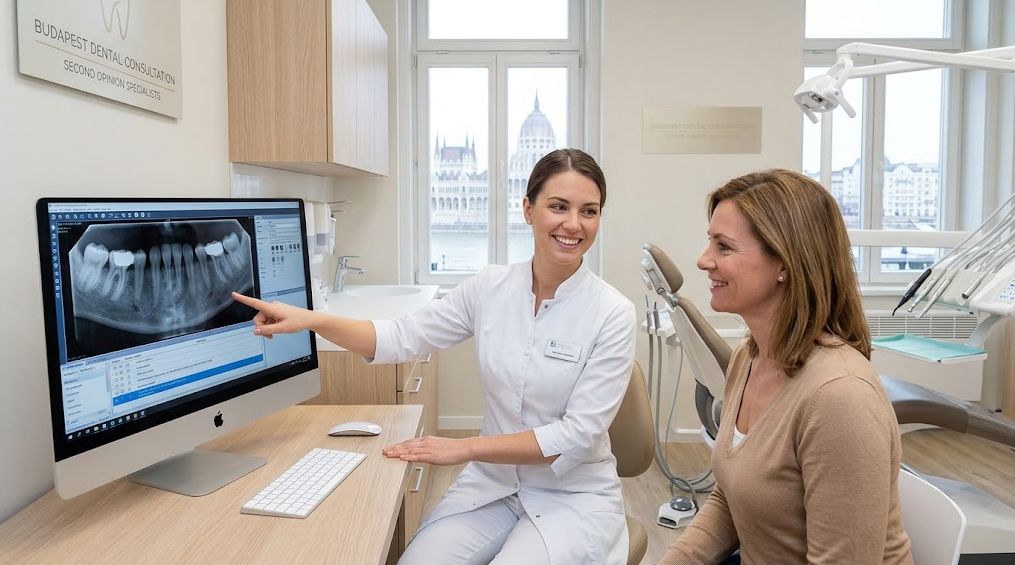
A remote review can clarify options before you spend money travelling. Its value depends on the quality of the records and whether a qualified clinician genuinely evaluates them.
1. Obtain Your Existing Records
Request your written plan, itemised quotation, relevant radiographs, clinical photographs and available examination findings.
If you already have a CBCT scan, ask for the original digital dataset, commonly supplied in DICOM format, and any associated report. Screenshots may omit information needed for meaningful assessment.
Do not arrange another scan solely because a promotional form requests one. A clinician should first determine whether existing imaging is adequate and whether further exposure is justified.
2. Transfer Information Securely
Ask the receiving clinic how it collects, stores and shares medical information.
Use its secure upload system or another agreed protected method. Confirm who will access your records and whether an outside agency is involved.
Include medication details, allergies, relevant medical conditions, smoking history and your priorities. These can change the recommendation as much as the images.
3. Speak to the Reviewing Clinician
A coordinator can explain appointments and costs, but clinical recommendations should come from the responsible dentist or relevant specialist.
During the consultation, ask:
-
Do you agree with the original diagnosis?
-
Which recommendations would you change, and why?
-
What can reasonably be preserved?
-
What cannot be established remotely?
-
What findings would change your proposed plan?
Request the reviewer’s name, qualifications and professional registration details.
4. Receive a Provisional Written Plan
The review should distinguish confirmed information from assumptions.
Expect a line-item quotation, proposed sequence, alternatives, approximate visit requirements and clear exclusions. Ask how any changes after examination would be communicated and authorised.
A remote review is not final surgical consent. You should retain the opportunity to reconsider after the in-person assessment, before irreversible treatment begins.
5. Managing Warranties, Aftercare and Travel Risks
An international treatment plan is incomplete until it explains what happens after you return home.
What If a Screw Loosens?
A loose crown or bridge component does not necessarily mean the implant itself has failed. However, it needs prompt professional assessment to identify the cause and avoid further damage.
Contact the treating clinic and follow its instructions. Do not attempt to tighten components yourself or continue chewing heavily on a moving restoration.
Before treatment, establish whether a local dentist can assess urgent problems and whether the Budapest provider will supply technical records and coordinate care.
What If an Implant Fails?
An implant may fail to integrate or develop problems later. Management depends on the cause, tissue condition and the wider reconstruction.
A warranty should explain whether removal, replacement surgery, additional grafting and restoration changes are covered. It should also identify circumstances in which further treatment is unsuitable.
Do not assume a manufacturer’s component warranty pays for clinical treatment, local emergency care or return flights.
Assess Aftercare Partnerships Carefully
Some providers arrange reviews through dentists in the patient’s home country. Others expect follow-up in Budapest or ask patients to organise local maintenance independently.
A claimed partnership needs practical detail:
-
Who is the local clinician?
-
Have they agreed to manage your particular restoration?
-
Which appointments and procedures are included?
-
Who pays, authorises treatment and handles disagreements?
-
What happens if the partnership ends?
Annual attendance may not be sufficient for every patient. Review frequency should reflect clinical risk and maintenance needs.
Build Travel Around Healing
Budapest is accessible by short-haul services from many European departure points. US journeys generally involve considerably longer travel, sometimes with connections.
Check current routes rather than relying on advertised flight times. Include transfers, recovery, appointment flexibility and the possibility that treatment cannot proceed as originally planned.
Implant integration commonly takes several months; grafting may extend the sequence. Immediate temporary teeth do not eliminate healing or guarantee that the definitive restoration can be completed during one visit.
Calculate the Total Cost of Ownership
Add together treatment, flights, accommodation, time off work, maintenance and a contingency for unexpected care.
Request the quotation’s currency, validity period, payment schedule and cancellation conditions. Confirm what happens financially if examination changes the plan.
For UK patients, do not assume the NHS will provide routine maintenance or corrective treatment free of charge. Check insurance carefully: ordinary travel cover may exclude planned treatment and related complications.
6. Turning a Second Opinion into a Confident Decision
The strongest second opinion may be less dramatic than you expect. It might confirm your current dentist’s proposal while explaining it more clearly.
That confirmation has value. You can proceed with a better understanding of why treatment is needed, which alternatives were considered and what uncertainties remain.
If the opinions differ substantially, ask both clinicians to address the same questions in writing. Focus on the diagnosis, prognosis and expected outcome rather than deciding which explanation sounds more confident.
A third, genuinely independent assessment may be worthwhile before multiple extractions or another major irreversible intervention.
Understand What “Independent” Means
A clinic reviewing your records may later offer to provide the treatment. That creates a commercial interest, even when the advice is professional and balanced.
The reviewer should disclose that position rather than presenting a treatment proposal as entirely detached advice. True independence is easier to establish when the assessor has no financial interest in the subsequent work.
Likewise, “specialist” or “certified” should refer to identifiable qualifications and registration, not an unexplained marketing label.
Your Next-Step Checklist
Before accepting either plan, make sure you can answer:
-
What conditions are being treated?
-
Which procedures are essential, optional or conditional?
-
What reasonable alternatives exist?
-
What is the complete expected cost?
-
How many visits and healing stages are anticipated?
-
Who manages maintenance, emergencies and complaints?
You do not need to become a dental expert. You need information that allows you to give informed consent without pressure.
To request a Budapest second opinion, submit your existing treatment plan, itemised quotation and available imaging for a preliminary clinical review. Ask whether that review is free, who performs it and whether the reviewer would also provide treatment.
A useful review should leave you better informed – even if you decide to stay with your local dentist.
FAQs
Why should I get a second opinion on my dental treatment plan?
A second opinion can help you understand whether the proposed treatment is necessary, what alternatives exist and whether the quotation covers the complete procedure. It is particularly useful before multiple extractions, extensive bone grafting or full-arch implant treatment. Seeking another assessment does not mean you distrust your current dentist.
What should I send for a remote dental second opinion in Budapest?
Provide your existing treatment plan, itemised quotation, relevant X-rays, available clinical photographs and medical history. If you already have a CBCT scan, ask for the original digital files and any associated report. The reviewing clinician should decide whether additional imaging is needed rather than asking you to arrange another scan automatically.
Can a remote consultation confirm my final treatment plan and price?
A remote review can provide a preliminary recommendation and estimated costs, but it cannot replace an in-person examination. Gum health, tooth mobility, bite and other clinical findings may change the proposal. Ask which items are provisional and how any changes would be explained, priced and authorised before treatment begins.
How do I compare a Budapest quotation with my local dentist’s plan?
Compare the diagnosis, teeth being retained or removed, implant system, restoration materials, temporary teeth and final prosthesis. Check whether both quotations include grafting, anaesthesia, reviews and adjustments. Add travel, accommodation, maintenance and possible return visits to understand the complete financial commitment.
Is a free second opinion from a Budapest clinic independent?
Not necessarily. A clinic that reviews your records and offers to perform treatment has a commercial interest, even when its advice is balanced and professional. Ask who reviews your case, check their qualifications and confirm whether they would provide the proposed treatment. A genuinely independent assessor has no financial interest in the subsequent work.
Sources
Patient guidance supporting the treatment-planning, implant-healing and international-aftercare considerations in this guide.
- General Dental Council: Going abroad for dental treatment
- Leeds Teaching Hospitals NHS Trust: Dental implants patient information
- Cambridge University Hospitals: Dental implants in restorative dentistry
- Guy’s and St Thomas’ NHS Foundation Trust: Dental implants overview
- Bupa Dental Care: 3D CBCT scans for dental implant planning
Last Updated on October 28, 2026 by LaPorta