Missing teeth are often seen as a cosmetic concern, but the reality is far more complex. Whether the result of decay, gum disease, trauma, or delayed treatment, tooth loss can have lasting consequences for oral health, overall wellbeing, and quality of life. For many UK patients, the challenge is not only understanding the risks but also finding accessible, effective solutions.
This guide takes a clear and practical look at why missing teeth should never be ignored, how they can be prevented, and the most reliable modern options for replacing them. It also reflects the growing role of dental tourism, with destinations such as Budapest offering advanced and affordable treatment pathways.
Why Missing Teeth Are a Serious Issue
The loss of a single tooth may not seem urgent, particularly if it is not visible when smiling. However, even one missing tooth can trigger a chain reaction in the mouth.
Teeth are designed to work together as a system. When one is lost, the surrounding teeth begin to shift into the empty space. This movement can disrupt alignment, affect the bite, and create areas that are harder to clean. Over time, this increases the risk of further decay and gum disease.
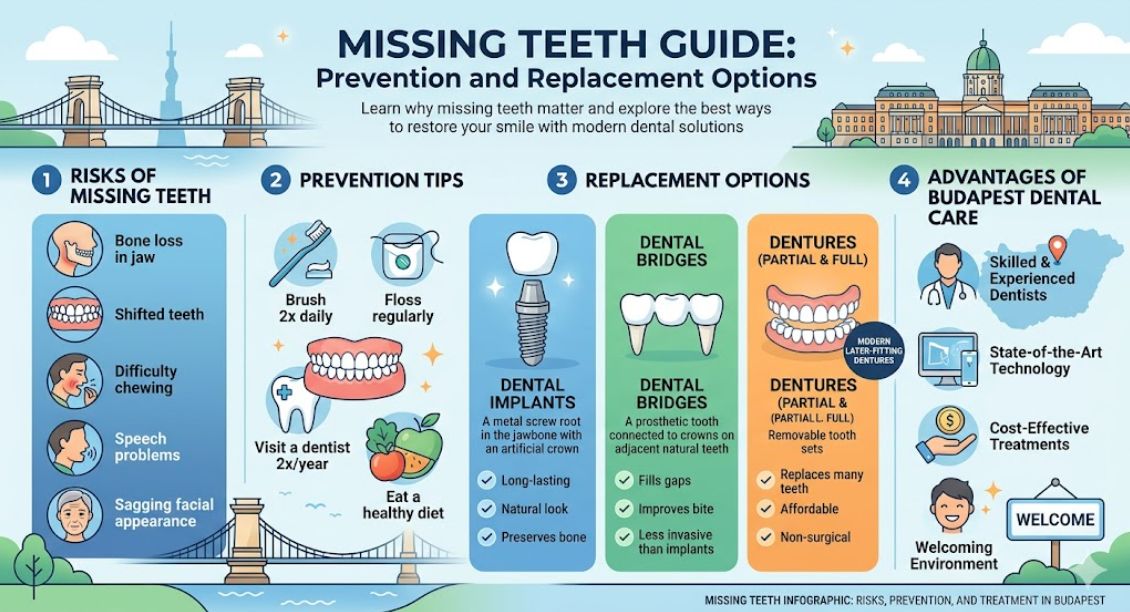
Bone loss is another critical concern. The jawbone relies on stimulation from tooth roots to maintain its density. When a tooth is missing, that stimulation disappears, and the bone in that area begins to shrink. This process, known as resorption (bone grafts can help too), can change facial structure and make future treatment more complex.
Beyond physical changes, missing teeth can affect speech, chewing ability, and confidence. Patients often adapt their eating habits, avoiding certain foods, which can impact nutrition. Social and psychological effects are also common, particularly when visible teeth are missing.
Common Causes of Tooth Loss
Understanding why teeth are lost helps in both prevention and treatment planning. The most common causes include untreated tooth decay, advanced gum disease, injury, and failed dental work.
Tooth decay remains one of the leading factors. When cavities are not treated in time, they can progress to infection, ultimately requiring extraction. Gum disease, particularly in its advanced stages, weakens the supporting structures of the teeth, leading to mobility and eventual loss.
Trauma, such as accidents or sports injuries, can result in immediate tooth loss. In some cases, teeth may be saved if treated quickly, but delays often lead to permanent damage.
In addition, older dental restorations, such as large fillings or crowns, can fail over time. Without proper maintenance, these can contribute to tooth loss as well.
Preventing Tooth Loss: Practical Steps That Matter
Prevention is always more straightforward and less costly than treatment. While not all tooth loss can be avoided, many cases are preventable with consistent care.
Regular dental check-ups are essential. Early detection of decay or gum disease allows for simple interventions before problems escalate. Professional cleaning also helps remove plaque and tartar that cannot be managed at home.
Daily oral hygiene plays a central role. Brushing twice a day with fluoride toothpaste and flossing regularly helps protect both teeth and gums. Attention to technique is just as important as frequency.
Diet also has a significant impact. Reducing sugar intake and maintaining a balanced diet supports oral health. Smoking cessation is another critical factor, as tobacco use is strongly linked to gum disease and tooth loss.
For patients involved in contact sports, protective measures such as mouthguards can prevent injury-related tooth loss.
What Happens If You Do Nothing
One of the most common misconceptions is that missing teeth can be left untreated without consequences. In reality, delaying replacement often leads to more complex and costly problems.
As neighbouring teeth shift, bite issues can develop, leading to uneven wear and strain on the jaw. This can contribute to discomfort and, in some cases, temporomandibular joint (TMJ) problems.
Bone loss continues over time, reducing the options available for replacement. For example, dental implants require sufficient bone support. If too much bone is lost, additional procedures such as bone grafting may be needed.
The longer treatment is delayed, the more extensive the intervention is likely to become.
Modern Solutions for Replacing Missing Teeth
Advances in dentistry have made it possible to restore missing teeth with highly effective and natural-looking solutions. The choice of treatment depends on factors such as the number of missing teeth, bone condition, and patient preferences.
Dental Implants: The Gold Standard
Dental implants are widely regarded as the most advanced solution for replacing missing teeth. They involve placing a titanium post into the jawbone, which acts as an artificial root. A crown is then attached to restore the visible part of the tooth.
Implants offer several advantages. They provide excellent stability, preserve bone structure, and function much like natural teeth. They also do not rely on adjacent teeth for support, which helps maintain overall oral health.
With proper care, implants can last for many years, making them a long-term investment.
Dental Bridges: A Fixed Alternative
Bridges are used to replace one or more missing teeth by anchoring a prosthetic tooth to the adjacent natural teeth. These supporting teeth are typically prepared by placing crowns over them.
Bridges offer a fixed solution and can restore function and appearance effectively. However, they require the alteration of healthy neighbouring teeth, which is an important consideration.
While not as durable as implants in the long term, bridges remain a reliable option for many patients.
Dentures: Flexible and Accessible
Dentures are removable appliances designed to replace multiple missing teeth or a full arch. They can be partial or complete, depending on the extent of tooth loss.
Modern dentures are more comfortable and natural-looking than older versions. They provide an accessible solution, particularly for patients seeking a lower-cost option.
However, dentures may require adjustment over time as the shape of the jaw changes. Some patients also find them less stable compared to fixed solutions.
Implant-Supported Dentures: Combining Stability and Value
For patients missing multiple teeth, implant-supported dentures offer a hybrid approach. A small number of implants are used to secure a denture in place, improving stability and comfort.
This option provides many of the benefits of implants while reducing the number of implants required. It is often chosen by patients seeking a balance between performance and cost.
Choosing the Right Treatment
Selecting the appropriate solution involves careful assessment and planning. Factors such as oral health, bone density, lifestyle, and budget all play a role.
A thorough consultation with a qualified dentist is essential. Diagnostic tools such as X-rays and 3D imaging help determine the best approach.
Patients should also consider long-term outcomes rather than focusing solely on initial costs. Investing in a durable solution can reduce the need for future treatment.
The Role of Dental Tourism in Tooth Replacement
For many UK patients, the cost of advanced treatments such as implants can be a barrier. This is where dental tourism becomes a practical option.
Destinations like Budapest have developed strong reputations for providing high-quality dental care at more accessible prices. Clinics in Budapest often specialise in implantology and full-mouth restoration, with experienced teams and modern facilities.
The cost difference can be significant, even when travel and accommodation are included. Patients can access treatments that might otherwise be out of reach within the UK.
Equally important is the standard of care. Many clinics operate within European regulatory frameworks and use internationally recognised materials and techniques.
The Patient Experience Abroad
Travelling for dental treatment requires planning, but the process is typically well structured. Clinics experienced in treating international patients provide clear guidance from the initial consultation through to follow-up care.
Patients often begin with a remote assessment, followed by scheduled visits for treatment. For implants, this may involve two stages, allowing time for healing between procedures.
Support services such as airport transfers and accommodation assistance help make the experience more manageable.
Addressing Concerns About Treatment Abroad
It is natural to have concerns about receiving treatment in another country. The key to a positive experience lies in careful research and choosing reputable providers.
Patients should verify qualifications, review case studies, and seek transparent communication. Established destinations like Budapest offer a level of consistency that helps reduce uncertainty.
Follow-up care is also an important consideration. Many clinics provide ongoing support and coordinate with local dentists if needed.
Long-Term Care After Tooth Replacement
Replacing missing teeth is only part of the journey. Maintaining the results requires ongoing care.
Good oral hygiene remains essential, particularly for implants and bridges. Regular dental visits help ensure that restorations remain in good condition.
Lifestyle factors such as diet and smoking also influence long-term outcomes. Patients who commit to maintaining their oral health are more likely to enjoy lasting results.
Final Thoughts
Missing teeth should never be viewed as a minor issue. The impact extends beyond appearance, affecting oral health, function, and overall wellbeing.
The good news is that modern dentistry offers a range of effective solutions, from implants to dentures, each tailored to different needs and circumstances. Early intervention and informed decision-making are key to achieving the best outcomes.
For UK patients facing financial or accessibility challenges, dental tourism provides a valuable pathway. Cities like Budapest combine expertise, technology, and affordability, making advanced treatment more accessible than ever.
Restoring a missing tooth is not just about replacing what was lost. It is about protecting long-term health, restoring confidence, and improving quality of life in a meaningful and lasting way.
Last Updated on April 24, 2026 by LaPorta