
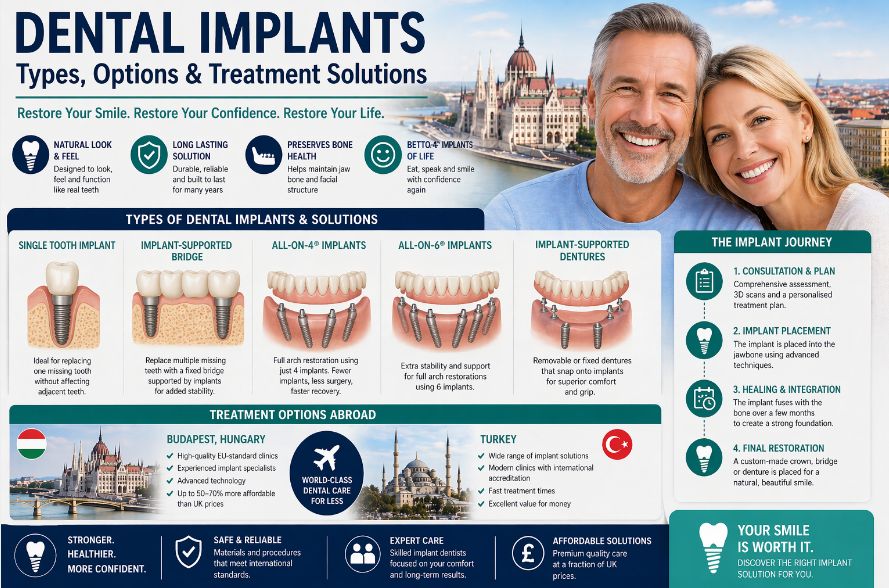
Dental implants have become one of the most reliable and transformative solutions in modern dentistry. For patients in the UK dealing with missing teeth, discomfort from dentures, or declining oral health, implants offer a long-term alternative that restores both function and appearance. As demand grows, so does the need for clear, practical guidance on the different types of implants, how they compare, and what patients can realistically expect.
This review provides a comprehensive look at dental implants, including single tooth implants, full-arch solutions such as All-on-4, and implant-supported dentures. It also explores how treatment options abroad, particularly in Budapest and Turkey, are shaping patient decisions in the UK.
What Are Dental Implants and How Do They Work
A dental implant is a small titanium or ceramic post that is surgically placed into the jawbone to act as a replacement for a natural tooth root. Once integrated with the bone through a process called osseointegration, the implant provides a stable foundation for a crown, bridge, or denture.
Unlike traditional solutions, implants do not rely on adjacent teeth for support. This preserves natural tooth structure and helps maintain bone density, which can deteriorate after tooth loss.
Implants are widely regarded as the closest alternative to natural teeth in both function and appearance. They allow patients to eat, speak, and smile with confidence, often improving quality of life significantly.
Single Tooth Implants: A Targeted and Durable Solution
Single tooth implants are used when one tooth is missing or needs to be replaced. The process involves placing a single implant into the jawbone, followed by a custom-made crown.
This option is particularly beneficial because it does not affect neighbouring teeth. In contrast, traditional bridges require adjacent teeth to be prepared or reduced, which can compromise their long-term health.
Single implants are known for their durability. With proper care, they can last many years, often decades. The crown attached to the implant may need replacement over time due to wear, but the implant itself is designed to be a long-term fixture.
For patients with good bone density and overall oral health, single tooth implants are often the most straightforward and predictable option.
Implant-Supported Bridges: Replacing Multiple Teeth
When several teeth are missing in a row, implant-supported bridges provide an effective solution. Instead of placing an implant for every missing tooth, a smaller number of implants can support a bridge that spans the gap.
This approach reduces the number of surgical placements required while still providing stability and functionality. It is a practical option for patients who want a fixed solution without the need for full-arch treatment.
Implant-supported bridges offer a natural appearance and allow for normal chewing function. They also help maintain bone structure in the areas where implants are placed.
Full Arch Implants: A Complete Transformation
For patients who have lost most or all of their teeth, full arch implant solutions provide a comprehensive alternative to traditional dentures. These treatments restore an entire row of teeth using a fixed prosthesis supported by implants.
All-on-4 Implants
The All-on-4 concept is one of the most widely recognised full arch solutions. It involves placing four strategically positioned implants to support a full set of teeth.
This method is designed to maximise the use of available bone, often avoiding the need for bone grafting. The implants are angled in a way that provides strong support for the prosthesis.
One of the key advantages of All-on-4 is efficiency. In many cases, patients can receive a temporary set of teeth on the same day as the implant placement. This immediate function is particularly appealing for those who want to avoid extended periods without teeth.
All-on-6 and Advanced Variations
In some cases, additional implants may be used to provide extra stability. All-on-6 and similar approaches involve placing six implants instead of four, distributing the load more evenly.
This can be beneficial for patients with higher bite forces or those seeking maximum durability. The choice between All-on-4 and All-on-6 depends on individual factors such as bone quality and treatment goals.
Implant-Supported Dentures: Stability with Flexibility
Implant-supported dentures combine the advantages of implants with the practicality of removable prosthetics. Instead of resting on the gums, these dentures are anchored to implants, providing greater stability.
There are two main types: removable and fixed.
Removable implant-supported dentures can be taken out for cleaning, but they remain securely attached during daily use. They are more stable than traditional dentures and reduce issues such as slipping or discomfort.
Fixed implant-supported dentures, on the other hand, are permanently attached and can only be removed by a dentist. They offer a more natural feel and function, closely resembling real teeth.
This category of treatment is often chosen by patients who want improved stability without committing to full fixed bridge solutions.
Traditional Dentures vs Dental Implants
Traditional dentures have been used for decades and remain a viable option for many patients. They are non-invasive and relatively affordable compared to implants.
However, dentures have limitations. They can become loose over time, require adhesives, and may cause discomfort or difficulty when eating. Bone loss in the jaw can also affect their fit.
Dental implants address many of these issues by providing a stable foundation. They help preserve bone structure and eliminate the need for adhesives.
While implants involve a higher initial investment, they often deliver greater long-term value in terms of comfort, function, and durability.
The Treatment Process: What Patients Can Expect
Dental implant treatment typically involves several stages. The first step is a comprehensive assessment, including imaging and evaluation of bone structure.
If the patient is suitable, the implant is placed surgically into the jawbone. A healing period follows, during which the implant integrates with the bone. This can take several months, depending on individual factors.
Once integration is complete, an abutment is attached to the implant, and the final restoration, such as a crown or bridge, is placed.
In some cases, additional procedures such as bone grafting or sinus lifts may be required to ensure sufficient support for the implant.
Factors That Influence Suitability
Not every patient is an immediate candidate for dental implants. Several factors influence suitability, including bone density, gum health, and overall medical condition.
Smoking, uncontrolled diabetes, and certain medications can affect healing and success rates. However, advances in techniques and materials have expanded the range of patients who can benefit from implants.
A thorough consultation is essential to determine the most appropriate treatment plan.
Longevity and Maintenance
Dental implants are designed to be long-lasting, but their success depends on proper care. Good oral hygiene, regular check-ups, and a healthy lifestyle all contribute to longevity.
While the implant itself can last for many years, the attached restoration may need replacement over time due to wear.
Patients who invest in implants often find that the long-term benefits outweigh the maintenance requirements.
Cost Considerations in the UK
In the UK, dental implants are typically available through private dentistry, with costs varying depending on the complexity of the case.
Single implants can be relatively expensive, while full-arch treatments represent a significant financial commitment. For many patients, this cost is a major factor in their decision-making process.
Insurance coverage is often limited, leaving patients to fund treatment themselves. This has contributed to the growing interest in exploring options abroad.
Treatment Options Abroad: Budapest and Turkey
For UK patients seeking more affordable implant solutions, travelling abroad has become an increasingly common choice. Destinations such as Budapest and Turkey offer a wide range of implant treatments at lower costs compared to the UK. Budapest is known for its strong dental reputation, EU-regulated standards, and experienced implant specialists, making it a preferred option for patients prioritising quality and long-term outcomes.
Dental clinics typically provide detailed treatment planning, modern technology, and structured follow-up care. Turkey, particularly cities like Istanbul and Antalya, is widely promoted for its competitive pricing and fast treatment timelines, especially for full smile makeovers and implant packages. While many clinics offer high-quality care, standards can vary more widely, so careful research is essential. For patients, the choice often comes down to balancing cost, consistency, and confidence in the provider.
Risks and Considerations
As with any surgical procedure, dental implants carry some level of risk. Complications can include infection, implant failure, or issues with integration.
Choosing an experienced clinician and following aftercare instructions significantly reduces these risks. Patients considering treatment abroad should also ensure that they understand the process for follow-up care.
Being informed and realistic about outcomes is key to a successful experience.
The Impact on Quality of Life
Dental implants do more than replace missing teeth. They restore confidence, improve speech, and allow patients to enjoy a wider range of foods.
For many individuals, the change is profound. The ability to smile without hesitation and eat comfortably can have a lasting impact on daily life.
This is why implants are often considered not just a dental treatment, but an investment in overall well-being.
Final Thoughts
Dental implants represent one of the most advanced and effective solutions in modern dentistry. Whether replacing a single tooth or restoring an entire arch, they offer stability, durability, and a natural appearance that few alternatives can match.
For UK patients, understanding the different types of implants and their benefits is essential when making an informed decision. From single implants to full-arch solutions like All-on-4, there is a wide range of options to suit different needs and circumstances.
With the added consideration of treatment abroad in Budapest and Turkey, patients now have more choices than ever. The key is to balance cost, quality, and long-term outcomes to achieve the best possible result.
Last Updated on May 19, 2026 by LaPorta