
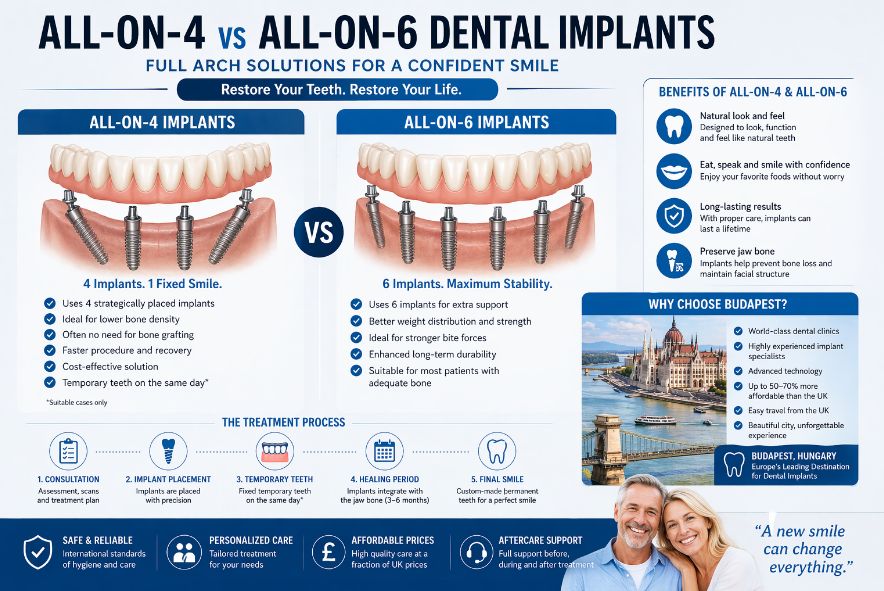
Full-mouth dental restoration has changed dramatically over the past two decades. Where traditional dentures once dominated, modern implant solutions now offer patients a stable, long-term alternative that restores both function and confidence. Among these, All-on-4 and All-on-6 dental implants have become two of the most widely discussed and requested treatments.
For UK patients facing extensive tooth loss, discomfort with dentures, or failing dental work, understanding these options is essential. This guide explains how All-on-4 and All-on-6 implants work, how they differ, who they are suitable for, and why many patients are increasingly considering treatment abroad, particularly in Budapest.
Table of Contents
ToggleUnderstanding Full-Arch Dental Implants
Full-arch dental implants are designed to replace an entire row of teeth using a fixed prosthesis supported by a small number of implants. Instead of replacing each tooth individually, a full set of teeth is anchored onto strategically placed implants in the jawbone.
This approach offers a significant improvement over traditional dentures. It provides stability, eliminates the need for adhesives, and allows patients to eat and speak more naturally.
The two most common variations are All-on-4 and All-on-6. Both aim to achieve the same goal, but they differ in the number of implants used and how they distribute support.
What Is All-on-4?
All-on-4 is a full-arch implant technique that uses four implants to support a complete set of teeth. Two implants are placed vertically at the front of the jaw, while the two at the back are angled to maximise contact with available bone.
This angled placement is a key feature. It allows the dentist to avoid areas with lower bone density and often eliminates the need for bone grafting. For many patients, this simplifies the treatment process and reduces overall time.
One of the most appealing aspects of All-on-4 is the possibility of immediate function. In many cases, patients receive a temporary fixed bridge on the same day as surgery. This means they can leave the clinic with a full set of teeth rather than waiting months.
What Is All-on-6?
All-on-6 follows the same principle as All-on-4 but uses six implants instead of four. The additional implants provide greater support and distribute biting forces more evenly across the jaw.
This can be particularly beneficial for patients with stronger bite forces or those seeking maximum durability. The increased number of implants also enhances stability, which may improve long-term outcomes.
Unlike All-on-4, All-on-6 may sometimes require more available bone or additional preparation like bone grafts and sinus lifts, depending on the patient’s anatomy. However, it offers a more robust foundation for the final prosthesis.
Key Differences Between All-on-4 and All-on-6
While both treatments aim to restore a full arch of teeth, the differences lie in structure, stability, and long-term performance.
All-on-4 is designed to be efficient and minimally invasive. It uses fewer implants and often avoids complex preparatory procedures. This makes it suitable for patients with lower bone density or those looking for a faster solution.
All-on-6, on the other hand, prioritises strength and distribution of force. With two additional implants, the load is spread more evenly, which can reduce stress on each individual implant.
In practical terms, All-on-4 implants may be ideal for patients seeking a quicker and more cost-effective solution, while All-on-6 is often chosen by those who want maximum durability and are suitable candidates for the additional implants.
Who Is Suitable for These Treatments
Both All-on-4 and All-on-6 are designed for patients who have lost most or all of their teeth, or whose remaining teeth are no longer viable.
Suitability depends on several factors, including bone density, gum health, and overall medical condition. Patients with significant bone loss may benefit more from All-on-4 due to its angled implant placement.
Those with sufficient bone and a desire for enhanced stability may be better suited to All-on-6. A detailed consultation, including imaging and clinical assessment, is essential to determine the best option.
Lifestyle factors also play a role. Smoking, oral hygiene habits, and general health can influence healing and long-term success.
The Treatment Process Step by Step
The journey typically begins with a comprehensive consultation. This includes digital scans, X-rays, and a detailed discussion of treatment goals.
Once a plan is agreed, the implants are placed surgically into the jawbone. For All-on-4, this often involves four implants placed in strategic positions. For All-on-6, six implants are used.
In many cases, a temporary prosthesis is fitted on the same day or shortly after. This allows patients to function normally while the implants integrate with the bone.
The healing period, known as osseointegration, usually takes several months. During this time, the implants fuse with the jawbone, creating a stable foundation.
After healing, the final prosthesis is fitted. This is custom-designed to match the patient’s facial structure and desired appearance.
Benefits of All-on-4 and All-on-6 Implants
These treatments offer a range of advantages that go beyond aesthetics. They restore chewing ability, improve speech, and eliminate the discomfort associated with removable dentures.
Patients often report a significant improvement in confidence and quality of life. The fixed nature of the prosthesis means there is no slipping or need for adhesives.
Bone preservation is another important benefit. Implants stimulate the jawbone, helping to prevent the bone loss that typically follows tooth loss.
From a practical perspective, maintenance is straightforward. Daily oral hygiene routines, combined with regular dental check-ups, help ensure long-term success.
Potential Risks and Considerations
As with any surgical procedure, there are risks to consider. These include infection, implant failure, and complications during healing.
Choosing an experienced clinician is crucial. Proper planning, precise placement, and adherence to aftercare instructions all contribute to successful outcomes.
Patients should also be aware that while implants are long-lasting, the prosthesis may need replacement over time due to wear.
Understanding these factors helps set realistic expectations and supports informed decision-making.
Cost Considerations for UK Patients
In the UK, full-arch implant treatments represent a significant investment. Costs can vary depending on the complexity of the case, the materials used, and the clinic.
All-on-4 is generally less expensive than All-on-6 due to the reduced number of implants and shorter treatment time. However, both options are considered premium solutions.
For many patients, cost is a key factor in exploring alternatives abroad.
Why Patients Consider Treatment Abroad
Travelling abroad for dental treatment has become increasingly common among UK patients. The combination of high domestic costs and limited insurance coverage encourages people to look for more affordable options.
At the same time, patients are seeking quality and reliability. This has led to the rise of established dental tourism destinations that cater specifically to international patients.
Budapest as a Leading Destination for Implant Treatment
Budapest has built a strong reputation as one of Europe’s leading centres for dental implant treatment. Its appeal lies in a combination of clinical expertise, modern facilities, and cost efficiency.
Hungarian dentists are highly trained, often with international experience. Clinics in Budapest invest in advanced technology, including digital planning and guided implant placement, which improves precision and outcomes.
Cost savings are a major advantage. Treatments such as All-on-4 and All-on-6 can be significantly more affordable than in the UK, even when travel and accommodation are included.
Accessibility is another benefit. Direct flights from the UK are frequent and relatively short, making it practical for patients to travel for consultations and procedures.
The Patient Experience in Budapest
Clinics in Budapest are well accustomed to treating international patients. Many offer comprehensive service packages that include airport transfers, accommodation assistance, and personalised treatment plans.
Communication is clear and professional, with English-speaking staff guiding patients through each stage of the process. This helps build confidence and ensures that patients understand their treatment fully.
Follow-up care is also structured, with clinics providing ongoing support after patients return home.
Comparing Value and Outcomes
When comparing treatment options, it is important to look beyond initial costs. Long-term outcomes, durability, and overall experience all contribute to value.
All-on-4 offers efficiency and accessibility, while All-on-6 provides enhanced stability and longevity. Both can deliver excellent results when performed correctly.
Choosing the right treatment depends on individual needs, clinical suitability, and personal priorities. For many UK patients, combining these treatments with care in Budapest offers a balance of quality and affordability.
Final Thoughts
All-on-4 and All-on-6 dental implants represent some of the most advanced solutions available for full-mouth restoration. They provide a stable, natural-looking alternative to traditional dentures and can transform both function and confidence.
Understanding the differences between these options is key to making an informed decision. While All-on-4 focuses on efficiency and accessibility, All-on-6 emphasises strength and long-term performance.
For UK patients, the option of treatment abroad in Budapest adds another dimension to the decision-making process. With its combination of expertise, modern technology, and cost advantages, Budapest continues to attract patients seeking reliable and high-quality implant care.
Ultimately, the best choice is one that aligns with individual needs, expectations, and long-term goals.
Last Updated on August 15, 2026 by LaPorta