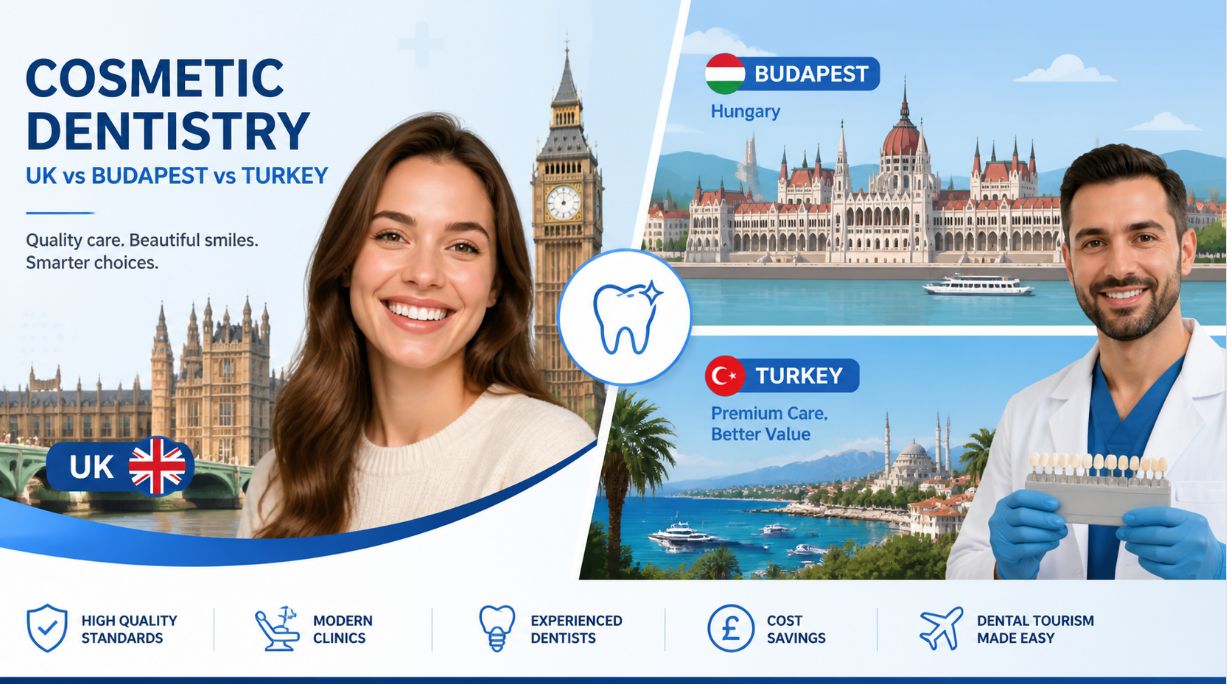
Cosmetic dentistry patients from the UK now routinely weigh up having treatment locally in cities like London, Manchester and Glasgow against travelling abroad to hubs such as Istanbul, Antalya or Budapest. Each option has clear strengths and trade‑offs in terms of cost, quality, safety, convenience and long‑term maintenance.
What counts as cosmetic dentistry?
Cosmetic dentistry focuses on improving the appearance of your teeth and smile, rather than treating medical emergencies alone. Typical treatments include teeth whitening, veneers, composite bonding, crowns, smile makeovers, orthodontic aligners, gum reshaping and implants for missing teeth.
In the UK, these procedures are usually provided on a private basis, as cosmetic work is rarely available on the NHS except where there is a clear clinical need. In popular dental tourism destinations such as Hungary and Turkey, the same range of aesthetic treatments is offered, but often packaged with travel and accommodation for international patients.
Cosmetic dentistry in the UK (London, Manchester, Glasgow)
Standards, regulation and clinical quality
The UK has one of the most tightly regulated dental systems in the world. Dentists must be registered with the General Dental Council (GDC), work under strict protocols, and are subject to national guidelines on cross‑infection control, consent and complaints procedures.
Major cities such as London, Manchester and Glasgow host many established private clinics that focus heavily on cosmetic and restorative work. These practices commonly offer digital smile design, Invisalign or other clear aligners, porcelain or composite veneers, whitening systems and implant‑based smile makeovers.
Costs in the UK
Private cosmetic dentistry in the UK is, by international standards, expensive. Depending on the procedure and location, prices can range from around £100 for minor cosmetic treatments up to well over £5,000 for complex cases such as full smile makeovers or multiple implants.
London practices in particular tend to sit at the top end of the price range due to higher overheads and demand for high‑end aesthetic work. Manchester and Glasgow clinics often offer more competitive pricing, but complex cosmetic treatment plans are still significantly more costly than in Hungary or Turkey.
Advantages of staying in the UK
-
Easy access for consultations and reviews: You can attend multiple face‑to‑face appointments before committing, and follow‑up or adjustments are straightforward to arrange.
-
Strong regulatory protection: If something goes wrong, you are protected by UK consumer law, GDC regulation and access to local complaint and redress systems.
-
No travel or accommodation logistics: There is no need to factor in flights, hotel stays or time abroad when planning treatment.
-
Continuity of care: Your cosmetic dentist can coordinate with your general dentist, and long‑term maintenance (for example repairing a chipped veneer or checking an implant) is simpler.
Limitations of UK cosmetic dentistry
-
Higher cost: Multiple sources consistently note that private cosmetic dental work in the UK is several times more expensive than equivalent work abroad.
-
Longer treatment duration: Because appointments are usually spread over weeks or months around your normal life, a full smile makeover can take longer overall compared with concentrated treatment abroad.
Cosmetic dentistry in Budapest, Hungary
Budapest has developed a reputation as a “dental capital of Europe”, drawing large numbers of British patients for cosmetic and implant dentistry. Clinics in the city are accustomed to treating international patients and typically offer packages combining treatment with travel support and accommodation.
Quality and expertise
Many Budapest clinics operate at a very high clinical standard, with experienced implantologists and cosmetic dentists, modern equipment and in‑house dental laboratories. This allows them to offer complex treatments such as full‑arch restorations, zirconia crowns and advanced smile makeovers on relatively short timescales.
Hungarian dentists often undergo extensive training and are used to managing large, comprehensive treatment plans in a condensed time frame for visitors. Clinics marketing to UK patients emphasise adherence to EU regulations, sterilisation standards and transparent pricing.
Costs and savings
Compared with the UK, private cosmetic dentistry in Hungary is significantly more affordable. Estimates suggest that dental procedures in Hungary can be around 60–70% cheaper than in the UK, even in reputable clinics. Individual reports highlight that some treatments can cost roughly one‑third of UK private prices, meaning that even once flights and hotels are included, most patients still make substantial savings.
Practical advantages of Budapest for UK patients
-
EU destination and relatively short flights: Budapest is within the EU, which reassures many UK patients regarding regulatory frameworks and product standards.
-
Established dental tourism infrastructure: Multiple clinics provide dedicated patient coordinators, English‑speaking staff, bundled packages and clear treatment plans upfront.
-
Time‑efficient treatment: Many cosmetic cases are planned so that diagnostics, preparation and fit stages are arranged over one or two focused visits lasting several days each.
Potential drawbacks in Budapest
-
Need for travel and planning: You must factor in flights, accommodation and time off work, and be comfortable receiving treatment in an unfamiliar country.
-
Follow‑up limitations: While many clinics offer good aftercare and remote support, minor complications once you are back in the UK may require a local dentist and can be more complex to organise.
-
Upfront commitment: Patients are often keen to complete treatment within a short visit, which can sometimes compress decision‑making compared with a series of UK consultations.
Cosmetic dentistry in Turkey
Turkey has emerged as one of the most competitive global destinations for cosmetic dentistry and full smile makeovers, including for UK patients. Popular centres such as Istanbul and Antalya host large dental hospitals and chains that cater almost exclusively to international clients.
Cost and value
Overall, Turkey typically offers the lowest headline prices among the destinations considered here. Price comparisons suggest that dental treatment can be 15–30% cheaper in Turkey than in Hungary, which is itself already much less expensive than the UK. For complex work like full‑mouth restoration, estimates put typical costs at roughly £8,000–15,000 in Turkey compared with £10,000–20,000 in Hungary, while UK prices can be substantially higher again.
This pricing structure makes Turkey especially attractive for extensive implant therapy, full‑arch zirconia restorations, or complete cosmetic rehabilitation that would be financially out of reach in the UK.
Facilities and treatment model
Many Turkish dental centres are large, multi‑disciplinary facilities that combine high patient volume with modern technology and on‑site laboratories. They are used to organising rapid treatment schedules for international visitors, often compressing diagnostics, extractions, implant placement and temporary restorations into one trip, with final prosthetics fitted on a second visit.
Turkey’s dental tourism industry is tightly integrated with the wider travel sector, so package deals including hotel, airport transfers and local support staff are commonplace.
Potential concerns in Turkey
-
Variation in standards: There are many excellent clinics, but the sector is large, and quality can vary, making careful research essential.
-
Distance and travel time: Turkey is farther from the UK than Budapest, which can be a factor for anxious flyers or those with limited time.
-
Aftercare back in the UK: As with any overseas dentistry, dealing with minor complications or adjustments once you return home can be more challenging and may involve extra cost with a UK dentist.
Key comparison: UK vs Budapest vs Turkey
The table below summarises the main differences that matter to UK patients considering cosmetic dentistry:
How to choose the right option for you
1. Nature and complexity of your treatment
The type and scale of cosmetic work you need is a major factor.
-
Minor cosmetic tweaks (for example single‑tooth bonding, subtle whitening or a small number of veneers) often make more sense to complete close to home, as the savings abroad may not justify travel and time away.
-
Larger treatment plans, such as full‑arch veneers, complex smile makeovers or extensive implant work, are where Budapest and Turkey can offer dramatic savings without necessarily compromising quality, provided you choose a reputable clinic.
2. Budget and financial priorities
If your budget is tight but you want a comprehensive cosmetic result, Turkey usually offers the lowest overall cost, followed by Budapest, with UK treatment the most expensive. However, it is essential to factor in:
-
Flights and accommodation
-
Potential future travel if a complication or adjustment is needed
-
The possibility that any corrective work back in the UK would be charged privately
When these variables are included, Budapest often hits a balance for UK patients: considerably cheaper than UK prices while remaining relatively accessible and covered by EU standards.
3. Attitude to travel and time away
Some patients enjoy the idea of pairing dentistry with a city break in Budapest or a sun holiday in Turkey; others prefer minimal disruption to home and work life.
-
If you have time flexibility and like the concept of “dental tourism”, overseas treatment may be attractive.
-
If you have caring responsibilities, a demanding job or travel anxiety, local care in London, Manchester or Glasgow will usually feel more manageable.
4. Risk tolerance and peace of mind
Any medical or dental procedure carries risk, regardless of location. However, distance can amplify the practical impact of complications.
-
Staying in the UK maximises your ability to return quickly to the treating dentist, access emergency care and rely on robust regulatory frameworks.
-
Travelling to Budapest or Turkey can be entirely safe and successful, but you should be comfortable trusting an overseas provider, carefully checking credentials, reviews, before‑and‑after cases and guarantees.
Practical tips if you are considering going abroad
For UK patients comparing Turkey and Budapest, a few practical steps help you make an informed decision.
-
Request a full written treatment plan and cost breakdown in advance, ideally based on recent X‑rays or scans, and ask about alternative options.
-
Check the clinic’s experience specifically with UK patients, including before‑and‑after photos and independent reviews.
-
Confirm who will perform each part of your treatment (general dentist, cosmetic dentist, implantologist, dental technician).
-
Ask about guarantees on crowns, veneers or implants, and exactly what happens if a problem arises once you are back in the UK.
-
Factor in the total cost of the trip, not just the procedure price, and compare that to at least two or three quotations from UK clinics.
Summary: UK vs Budapest vs Turkey for UK cosmetic patients
For UK‑based patients, local cosmetic dentistry in London, Manchester and Glasgow offers the reassurance of strong regulation, easy access and straightforward aftercare, but at a premium price. Budapest stands out as a well‑established EU dental tourism hub, combining substantial savings with high clinical standards and relatively short flights. Turkey typically provides the lowest overall costs and large, modern facilities, especially attractive for full‑mouth or implant‑heavy cases, but requires careful clinic selection and acceptance of greater distance for any future reviews.
Last Updated on August 15, 2026 by LaPorta