Summary
You should not fly home from Budapest with a visible gap. A well-planned implant treatment includes a temporary tooth, bridge or denture while the implants heal, which commonly takes about 3–6 months.
- Four main options: an Essix retainer, a removable flipper, a temporary fixed bridge, or an immediate-load fixed temporary for suitable full-arch cases. The right one depends on your mouth and your dentist’s assessment.
- Immediate-load teeth are not guaranteed. They depend on implant stability on the day, so ask what the backup is.
- Ask whether temporaries are included. Full-arch packages often include them, while single-tooth and small-bridge quotes often list them separately.
- Published Budapest price lists vary. Examples I found were roughly €35–€210 per temporary crown or bridge unit, €290–€400 for a removable temporary denture and about €1,100–€1,200 for a separately listed full-arch temporary. Treat these as rough guides, not quotes.
- Ask three questions about your itemised plan. What exactly is included, what happens if the planned temporary cannot be used, and what do repairs and adjustments cost?
- Book your flight after your post-operative check. Sources commonly suggest waiting at least a few days, and longer after complex surgery.
- UK and Irish patients can plan for a short-haul adjustment trip if needed. US patients should prioritise a durable temporary, a repair plan and an agreed aftercare route before leaving.
- Seek prompt local care for urgent symptoms. These include bleeding that will not stop, increasing swelling, fever or a loose fixed temporary.
Temporary Teeth for Budapest Dental Implants: Options, Costs and What to Expect Between Visits
No, you should not fly home from Budapest with a visible gap. A well-planned implant treatment includes a temporary tooth, bridge or denture for the months while your implants bond with the jawbone. The exact option depends on your case, and you should have it agreed in writing before you book flights.
This guide covers the four common temporary options, what they cost, and how to read your quote so you avoid surprise charges. It also covers how to manage the flight home and the months between trips.
Prices and timelines here are general guides, not a quote or a promise. Your dentist decides what is suitable after examining you and reviewing your scans.
The Two-Trip Timeline in Plain English
Most Budapest implant plans follow a two-trip pattern.
Trip one usually covers the consultation, scans, any extractions and implant placement. Many clinics also arrange the temporary teeth on this trip. A single implant plan often takes a few days, while complex or full-arch treatment may need longer.
The healing period follows at home. The implant integrates with the bone, a process called osseointegration. It commonly takes about three to six months, although some people need longer.
Trip two is when the final crown, bridge or full-arch restoration is fitted, once your dentist confirms the implants have healed.
During healing, the implant needs protection from heavy chewing forces. A temporary restoration fills the gap, supports your appearance and speech, and keeps the area protected. It is a bridge between the two trips, and it should be designed for that job rather than added as an afterthought.
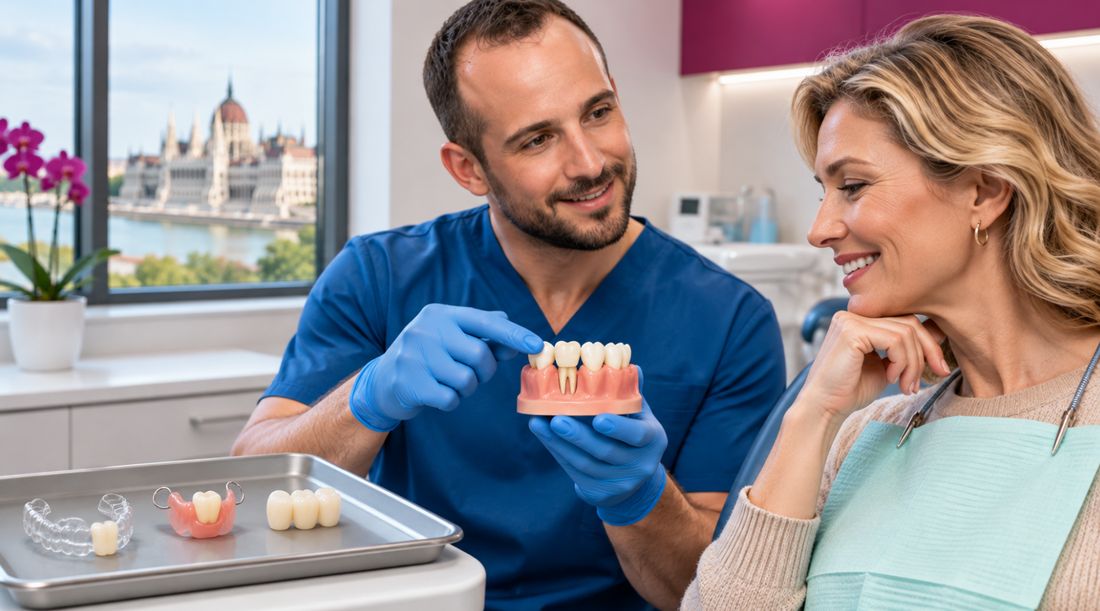
Four Types of Temporary Teeth
1. Essix retainer with a replacement tooth
An Essix retainer is a thin, clear plastic tray that fits over your teeth. A tooth-coloured replacement is built into the gap.
-
Best for: A single missing front tooth, where appearance matters most and the surrounding teeth are healthy.
-
Pros: It is discreet and lightweight, and it does not rely on clasps or cement.
-
Cons: It is removable and can feel tight at first. It is not designed for hard or sticky food, and it can crack if you bite on it firmly.
-
Practical note: Ask for a spare or a repair plan, because a cracked retainer is difficult to fix mid-journey.
2. Removable partial denture (“flipper”)
A flipper is a lightweight acrylic denture with one or a few teeth that clips or rests against the neighbouring teeth.
-
Best for: A budget-friendly option for one to three missing teeth, or for cases where fixed options are not suitable.
-
Pros: It is quick to make, easy to adjust and inexpensive.
-
Cons: It can feel bulky and may affect speech at first. It is not suited to demanding chewing and may be less stable at the back of the mouth.
-
Practical note: Practise speaking aloud and wearing it before you return to work. Read your clinic’s advice on whether to wear it at night.
3. Temporary fixed bridge
A temporary bridge is cemented onto neighbouring teeth that have been prepared to support it. It is not removable by the patient.
-
Best for: Patients who want a fixed-feeling option and have suitable teeth next to the gap.
-
Pros: It is secure and does not need to be taken out for cleaning in the same way as a flipper.
-
Cons: It requires preparing neighbouring teeth and is not suitable for every mouth. Temporary cement can loosen, and cleaning underneath needs care.
-
Practical note: If neighbouring teeth are already crowned or planned for crowns, a fixed bridge may fit neatly into your overall plan. Otherwise ask whether preparing healthy teeth is justified for a temporary solution.
4. Immediate-load fixed temporaries for full-arch treatment
In suitable full-arch cases, such as All-on-4 or All-on-6, a fixed temporary prosthesis can be screwed onto the implants shortly after surgery. Clinical sources describe immediate loading as depending on primary implant stability, bone quality and bite control. It is not guaranteed, and some patients are advised to wait.
-
Best for: Full-jaw cases where the surgeon confirms the implants are stable enough on the day.
-
Pros: You leave with fixed teeth, which many patients find reassuring.
-
Cons: It is not a normal set of teeth. Hard or tough foods remain restricted, the prosthesis may need adjustments, and in some patients a removable temporary denture is safer.
-
Practical note: Ask what happens if the implants are not stable enough for immediate loading. A responsible clinic should have a backup plan and tell you what it costs.
Quick comparison
| Option | Fixed or removable | Best suited to | Main limitation |
|---|---|---|---|
| Essix retainer | Removable | Single front tooth | Delicate; not for hard foods |
| Flipper | Removable | One to three teeth, budget-focused | Bulkier; may affect speech at first |
| Temporary fixed bridge | Fixed to neighbouring teeth | Gaps with suitable adjacent teeth | Requires tooth preparation; cement may loosen |
| Immediate-load full-arch temporary | Fixed to implants | Selected full-arch cases | Depends on stability; chewing remains restricted |
What to Eat, Say and Do at Work
Most people adapt quickly, but the first week is the hardest.
-
Eating: Expect a soft diet at first. Follow your surgeon’s written advice, because it differs between single implants and full-arch cases. A fixed temporary does not make hard or sticky food safe.
-
Speaking: Removable appliances and full-arch prostheses can change how certain sounds feel. Read aloud at home for a few days before important meetings.
-
Working: If you present, teach or take client calls, plan a few quiet days after surgery. Swelling is common and often peaks around the second or third day.
-
Cleaning: Use a soft brush and follow your clinic’s instructions for cleaning around the temporary teeth. Do not improvise with water flossers or strong rinses unless your dentist says so.
Your clinic should tell you who to contact if a temporary tooth breaks, feels loose or comes off.
Are Temporary Teeth Included in the Price?
It depends on the clinic, the treatment and how the quote is written.
In full-arch packages, a fixed temporary prosthesis is often included in the headline price. Some clinics, however, list it separately or quote a removable temporary denture instead. For single implants and small bridges, temporary crowns are frequently listed as separate lines on the price list.
This is why itemised quotes matter. A low advertised price may not include the temporary teeth you expect.
Ballpark figures from Budapest price lists
These figures come from publicly listed clinic prices that I checked, not from a market average. They vary by clinic, materials and case, and they may have changed since publication. Conversions are approximate, at about €1 ≈ £0.87 ≈ $1.10, so check the current exchange rate before you budget.
| Temporary item | Approximate EUR | Approximate GBP | Approximate USD |
|---|---|---|---|
| Short-term temporary crown, per tooth | €35–€50 | £30–£45 | $40–$55 |
| Longer-term temporary crown or bridge unit | €80–€210 | £70–£185 | $90–$230 |
| Temporary removable denture (per jaw) | €290–€400 | £250–£350 | $320–$440 |
| Fixed temporary prosthesis for full-arch treatment, where listed separately | around €1,100–€1,200 | around £960–£1,050 | around $1,200–$1,320 |
Several Budapest clinics list temporary crowns at a few tens of euros per unit, and some list longer-term temporaries at around €100–€210. Full-arch temporaries are priced much higher where they are listed separately. Some packages include them in the total, which is why a quote that lists them separately is not necessarily worse. It is simply a different way of presenting the same cost.
I could not find reliable public price lists for Essix retainers, so ask any clinic offering one for a written price.
Three questions to ask about your itemised plan
-
Which temporary solution is included in this price, and what exactly is it? Ask for the type (removable, tooth-supported or implant-supported), the material and the number of units, rather than accepting “temporary teeth included”.
-
What happens if the planned temporary cannot be used? For example, if immediate loading is not clinically suitable on the day, what is the alternative and who pays for it?
-
What do repairs, remakes and adjustments cost? Ask whether a cracked flipper, a loose temporary bridge or an adjustment visit is covered, and how you would get help from home.
Flying Home from Budapest Airport (BUD)
Timing
Do not book your return flight until your surgeon has told you when travel is appropriate. Sources vary. One review cited in clinic guidance suggests at least 72 hours after implant placement, and about a week where plans allow. Longer is usually advised after sinus lifts, bone grafting or complex multi-implant surgery.
The better rule is to book after your post-operative check, not before. If you must book early, choose a flexible fare.
What to pack in your carry-on
-
Your prescribed medication, kept in your hand luggage.
-
Sterile gauze.
-
A soft toothbrush and any rinse your clinic recommended.
-
Written aftercare instructions and the clinic’s emergency contact number.
-
A copy of your treatment summary and any scan or implant record, which your home dentist may need.
-
A small water bottle, because cabin air is dry.
On the plane
Cabin pressure does not damage an implant in the bone. The more practical concerns are the early days after surgery: bleeding, swelling and being a long way from your dentist. Drink water, avoid alcohol, eat soft foods and take your pain relief as directed.
Do not fly if bleeding has not stopped or swelling and pain are increasing. Contact your clinic first. Fever, pus, a bad taste or difficulty swallowing need prompt medical attention.
UK and Irish Patients: Short-Haul Flexibility
Budapest is a short flight from many UK and Irish airports. Direct flights typically take around two and a half hours from London, with similar times from Dublin and a somewhat longer journey from Edinburgh or Glasgow, depending on the route.
That makes a quick adjustment trip more realistic than it is for patients from further afield. If a temporary breaks or a tooth-supported temporary bridge loosens, a short return visit is practical for some people, although it still costs time and money.
Even so, do not plan on flying back for every minor problem. Ask your clinic what it can fix remotely, which issues need a visit and whether you should see a local dentist for urgent comfort care.
Irish patients should keep itemised invoices, because qualifying treatment may be relevant for tax relief. Check that with Revenue, not with the clinic.
US Patients: Plan for Durability
For US patients, a surprise return trip is a major undertaking. Prioritise the most durable, lowest-maintenance temporary your dentist considers safe.
Practical steps:
-
Ask whether a fixed temporary is clinically appropriate. A removable appliance that breaks mid-journey is harder to fix when you are thousands of miles away.
-
Ask the clinic to provide a spare or repair plan for any removable appliance.
-
Ask which temporary dental adhesive or wax is acceptable. Do not improvise with household glues, and do not use any product unless your dentist has approved it.
-
Identify a local US dentist before you leave. They can help with an emergency, but they may not be able to modify or repair a prosthesis made abroad.
-
Build in extra days. If your surgeon wants to see you before you fly, a rushed itinerary is a risk, not a saving.
Also consider flight-day practicalities such as time zones, long seated hours and medication timing. Keep your medication in your carry-on, not your checked luggage.
When to Seek Help Quickly
Contact your clinic and seek local care promptly if you notice any of the following:
-
Bleeding that does not stop with firm pressure.
-
Swelling that keeps increasing after the first few days.
-
Fever, pus or a persistent bad taste.
-
Difficulty swallowing or breathing, which needs emergency care.
-
A temporary that comes off or feels loose, particularly a fixed one attached to implants.
Do not wait for an overseas reply if your symptoms are urgent. Your clinic’s aftercare plan should tell you who to contact and when.
Five Questions to Send a Clinic Before Booking Flights
Copy these into an email and ask for written answers.
-
Which temporary teeth will I have, and are they included in the quoted price? Please state the type, the material and the cost if they are listed separately.
-
What is the backup if the planned temporary is not clinically suitable? For full-arch cases, ask specifically what happens if immediate loading cannot be done.
-
What diet, speech and work expectations should I plan for? Ask for written guidance, including what I should avoid eating.
-
What are the charges and procedures for repairs, remakes and adjustments? Ask about both in-clinic visits and any remote or home-country support.
-
When can I safely fly, and what support do I have after I leave? Ask when the post-operative check takes place, who handles urgent questions and what the clinic recommends if I need local care.
A clear, specific reply is a good sign. Vague promises or reluctance to answer in writing deserve a pause before you pay a deposit.
Final Thoughts
Temporary teeth are a normal, planned part of implant treatment. They protect the healing area and keep you functioning while you wait.
Choose the option that suits your mouth, your work and your travel distance. Make sure the quote explains what is included. Ask what happens if a temporary breaks, and agree your aftercare route before you fly out.
If you are comparing Budapest clinics, request a treatment plan that names the temporary solution and its price. A clinic that explains the temporary stage clearly is more likely to be organised about the rest.
Frequently Asked Questions
Will I have to fly home without teeth after implant surgery in Budapest?
No, a well-planned treatment includes a temporary solution so you do not leave with a visible gap. The type depends on your case. It might be an Essix retainer, a removable flipper, a temporary bridge or, in suitable full-arch cases, a fixed temporary on the implants. Ask the clinic to confirm your temporary option in writing before you book flights.
How long do I wear temporary teeth before the final restoration?
Implant healing commonly takes about three to six months, although some patients need longer. Your dentist decides when the implants are ready for the final crown, bridge or full-arch restoration. Your return trip should be scheduled around that clinical decision, not around a fixed date promised in advance.
Are temporary teeth included in Budapest implant prices?
It depends on the clinic and the treatment. Full-arch packages often include a temporary prosthesis in the price, while temporary crowns, bridges and dentures for smaller cases may be listed as separate items. Ask for an itemised plan that names the type of temporary, its price and any repair or adjustment costs.
Can I eat normally with temporary teeth?
Not usually. Expect a soft diet at first, then follow your surgeon’s written advice. Even a fixed temporary on implants does not allow unrestricted chewing, and hard or sticky foods can damage the temporary or disturb healing. Ask your clinic for a food guide that matches your type of treatment.
What should I do if a temporary tooth breaks or comes loose after I get home?
Contact your clinic for advice, and see a local dentist if you are in pain or have an urgent problem. Do not use household glue or improvised repairs. Keep any broken parts and bring them to your appointment. Seek prompt medical attention for heavy bleeding, increasing swelling, fever or difficulty swallowing, and do not wait for an overseas reply.
Sources
- My Specialty Dentist: Temporary bridge options during implant healing — Flipper, Essix, bonded and implant-supported temporaries.
- NV Implant Center: Temporary tooth options during implant healing — Typical 3–6 month healing and common temporary options.
- btyDENTAL: Temporary teeth options while waiting for implants — Removable and fixed temporary categories.
- High Tech Dental Seminars: Immediate-load full-arch implants — Clinical conditions for fixed provisional prostheses and when delayed loading is safer.
- Full Arch Masters: Same-day full-arch protocol — Primary stability, provisional design and follow-up timing.
- Flying home after dental treatment — Timing guidance referencing a 2023 British Dental Journal paper and warning signs.
- Greenfield Clinic: Flying after dental implants or a sinus lift — Post-operative review before flying and in-flight care.
- Papatya Dental: Long flights after dental treatment — Bleeding, swelling and proximity to a dentist.
- Jókai Dental Clinic: Price list · Helvetic Clinics: Price list · La Porta Dental: Price list — Published clinic prices for temporary crowns, dentures and full-arch temporaries.
- Hungary Unlocked: Dental prices in Hungary — Public price-list ranges for temporary crowns and the advice to request itemised lines.
- In Your Pocket: Dental tourism in Budapest — Two-trip structure and the importance of itemised quotes.
- Dentist for You: Dental implants in Budapest, costs and treatment guide — Cost components and temporary options in a Budapest clinic’s guide.
Last Updated on November 27, 2026 by LaPorta