In 2026, the landscape of the National Health Service (NHS) dentistry has reached a historic crossroads. For decades, the UK public relied on the “cradle to grave” promise of affordable, state-subsidised dental care. However, as we navigate this year, the reality for the average patient in England, Wales, Scotland, and Northern Ireland has shifted dramatically.
Whether you are struggling to find a practice taking on new patients or you are confused by the ever-evolving “Bands” of payment, understanding the NHS pricing structure is essential. As a dental tourism expert, I often see patients who turn to international options not just because they want “luxury” care, but because the NHS framework has become increasingly difficult to navigate.
This comprehensive review breaks down exactly what you will pay in 2026, what that money actually buys you, and why “cheap” dentistry can sometimes be the most expensive mistake a patient makes.
1. The Three-Tier System: Understanding NHS Dental Bands in 2026
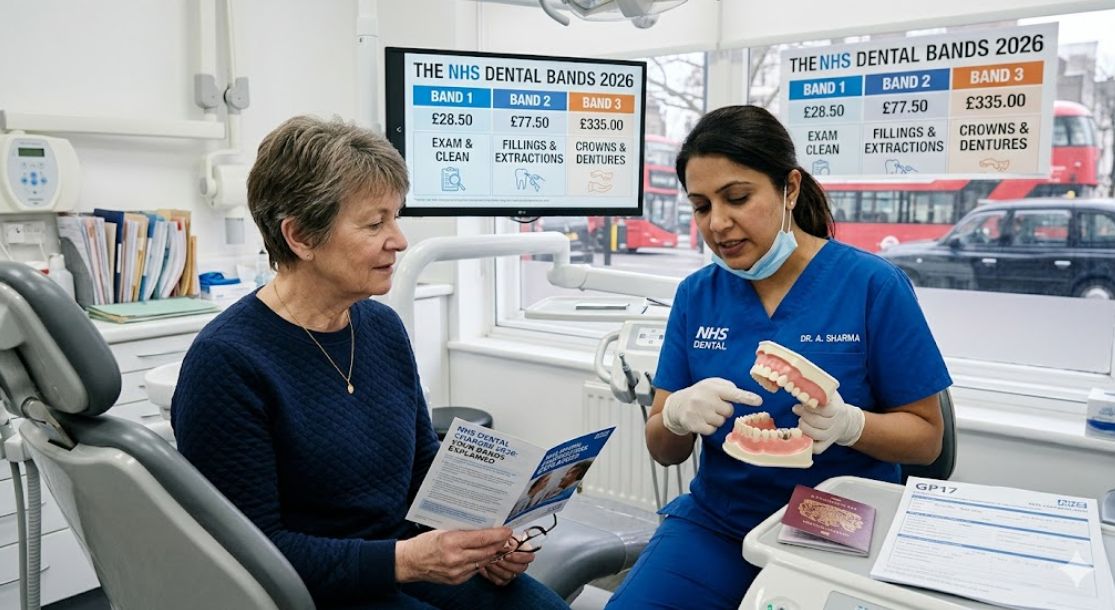
NHS dentistry in England is governed by a fixed-fee structure divided into three distinct “Bands.” Unlike private dentistry, where you pay per item (e.g., £150 per filling), the NHS charges a flat rate for a course of treatment, regardless of how many individual tasks are performed within that category.
Band 1: The Maintenance Tier
Estimated 2026 Cost: £28.00 – £30.00
This is your entry-level charge. It covers the basics required to monitor your oral health.
-
What’s Included: Clinical examination, x-rays, scale and polish (only if clinically necessary), and preventative advice.
-
The Reality: In 2026, the “scale and polish” has become a point of contention. Many NHS dentists will only provide a basic clean if there is a medical risk; cosmetic stain removal is almost exclusively pushed to private hygienist appointments.
Band 2: The Restorative Tier
Estimated 2026 Cost: £75.00 – £80.00
If your check-up reveals a problem, you move into Band 2. This covers all treatments from Band 1 plus “minor” restorative work.
-
What’s Included: Fillings, root canal work, and tooth extractions.
-
The Reality: The NHS predominantly uses silver amalgam for back teeth fillings. If you want white composite fillings for a “natural” look on your molars, you will likely be quoted a private upgrade fee, as the NHS views white fillings on back teeth as a cosmetic choice rather than a clinical necessity.
Band 3: The Complex Tier
Estimated 2026 Cost: £320.00 – £340.00
This is the highest charge and covers procedures that require laboratory work (items made outside the mouth).
-
What’s Included: Crowns, bridges, and dentures.
-
The Reality: While Band 3 covers crowns, the materials used are often basic. For example, a Band 3 crown is usually metal-ceramic (PFM). If you desire a high-aesthetic, metal-free zirconia or E-max crown, this is rarely available under the NHS price cap.
2. NHS Charges Across the UK: A Comparative Review
It is a common misconception that NHS dental costs are uniform across the United Kingdom. In 2026, the “Postcode Lottery” of dental charges is more pronounced than ever.
| Region | Band 1 (approx.) | Band 2 (approx.) | Band 3 (approx.) |
| England | £28.50 | £77.50 | £335.00 |
| Wales | £20.00 | £60.00 | £260.00 |
| Scotland | Varies (Fee-per-item) | Varies | Cap at £384.00 |
| N. Ireland | Varies (Fee-per-item) | Varies | Cap at £384.00 |
-
Scotland and Northern Ireland: These regions operate on a different system. Patients pay 80% of the cost of the treatment up to a maximum “cap.” This often makes complex work slightly more expensive than in England, but routine work can be cheaper depending on the specific tooth involved.
3. The “Free” List: Who Escapes the Charges?
Despite the rising costs, a significant portion of the UK population remains exempt from NHS dental charges. In 2026, you generally do not have to pay if, when the treatment starts, you:
-
Are under 18 years of age (or under 19 and in full-time education).
-
Are pregnant or have had a baby in the last 12 months.
-
Are staying in an NHS hospital and the treatment is carried out by the hospital dentist.
-
Are receiving specific low-income benefits (Income Support, Jobseeker’s Allowance, Universal Credit—though thresholds apply).
Expert Warning: Always check your exemption status before signing the “GP17” form. The NHS Business Services Authority (NHSBSA) has ramped up automated checks in 2026. Claiming free treatment when you aren’t entitled can result in a £100 penalty charge plus the original cost of treatment.
4. The “Access Crisis” of 2026: Why Having the Money Isn’t Enough
The biggest issue facing UK patients this year isn’t the cost of NHS dentistry—it’s the availability.
The current NHS dental contract pays dentists based on “Units of Dental Activity” (UDAs). This system has led to what many call a “Dental Desert.” Because dentists are paid the same amount for one filling as they are for five fillings in a single Band 2 course, many practices find it financially impossible to treat high-needs patients under the NHS.
The Result: * Waitlists: Some NHS waitlists for new patients in rural parts of the UK now stretch to 36 months.
-
The “Private-Only” Shift: Many former NHS dentists are handing back their contracts to work exclusively as private clinicians, where they can spend more time with patients and use superior materials.
5. NHS vs. Private: Is the “Cheap” Option Actually a Compromise?
If you are lucky enough to have an NHS dentist, you might wonder if you should stick with it or pay the higher private fees. Here is an expert comparison of the clinical reality in 2026.
Materials and Durability
NHS dentures are typically made from standard cold-cure acrylic, which can be brittle and less lifelike. Private dentures often use high-impact resins or flexible Valplast materials.
Time and Technology
Under the NHS Band system, a dentist is often allocated 15–20 minutes for a filling. In a private setting, that same appointment might be 45 minutes, allowing for “Rubber Dam” isolation (which significantly increases the lifespan of a filling) and high-magnification loupes.
Aesthetics
The NHS is a “health” service, not a “beauty” service. If you have a missing tooth at the back of your mouth, the NHS solution is often a chrome-cobalt partial denture. If you want a dental implant to replace that tooth, you will almost never get this on the NHS unless it is required due to oral cancer or severe trauma.
6. When the NHS Isn’t Enough: The Dental Tourism Pivot
This access crisis is exactly why dental tourism has surged among “average” earners in the UK.
Ten years ago, people went to Budapest or Turkey for “Hollywood Smiles.” In 2026, they are going for basic restorative care. When a patient is told they need three crowns and a bridge (a Band 3 charge of £335), they might feel the NHS is a bargain. But when they find out the wait is 18 months, or that the “Band 3” crowns will be bulky and metallic, the prospect of a £2,000 private bill in the UK vs. a £800 bill in Budapest (with immediate availability, check prices here) becomes a logical financial decision.
7. How to Lower Your Dental Costs in the UK
If you want to stay within the UK system, there are a few “insider” ways to manage the burden of dental charges:
-
Dental Schools: Universities in cities like London, Leeds, and Cardiff offer free or highly discounted treatment. The work is performed by students but supervised by world-class consultants. The downside? Appointments take much longer.
-
The HC2 Certificate: If you are just above the threshold for benefits, apply for the NHS Low Income Scheme (HC2). It can provide full or partial help with dental costs.
-
Community Dental Services: If you have severe anxiety or physical disabilities, you may be eligible for the Community Dental Service, which often has different access criteria than high-street practices.
8. Summary: The Expert’s Verdict for 2026
The NHS dental system in 2026 remains a vital safety net, but it is a net with increasingly large holes. The costs are transparent and relatively low, but the “value” is tied to clinical necessity, not patient preference or aesthetic desire.
-
Choose the NHS if: You have a healthy mouth, no major aesthetic concerns, and an existing relationship with a practice.
-
Choose Private/Tourism if: You require implants, want metal-free restorations, need complex root canal work, or simply cannot wait two years for an appointment.
Final Thought: The most expensive dental charge is the one you pay twice. If you opt for a low-cost NHS solution that fails due to time constraints or material limitations, the subsequent “fix” will almost always cost more than doing it correctly the first time.
Last Updated on April 26, 2026 by LaPorta